Rethinking WASSCE English requirements to expand access to STEM education in Sierra Leone.
Part Two highlights: READ: “Strengthening English Through Partnership.” Part Three will explore “Open the Door to Science: Rethinking the WASSCE English Requirement as a Barrier to University Admission.” A four-part series.
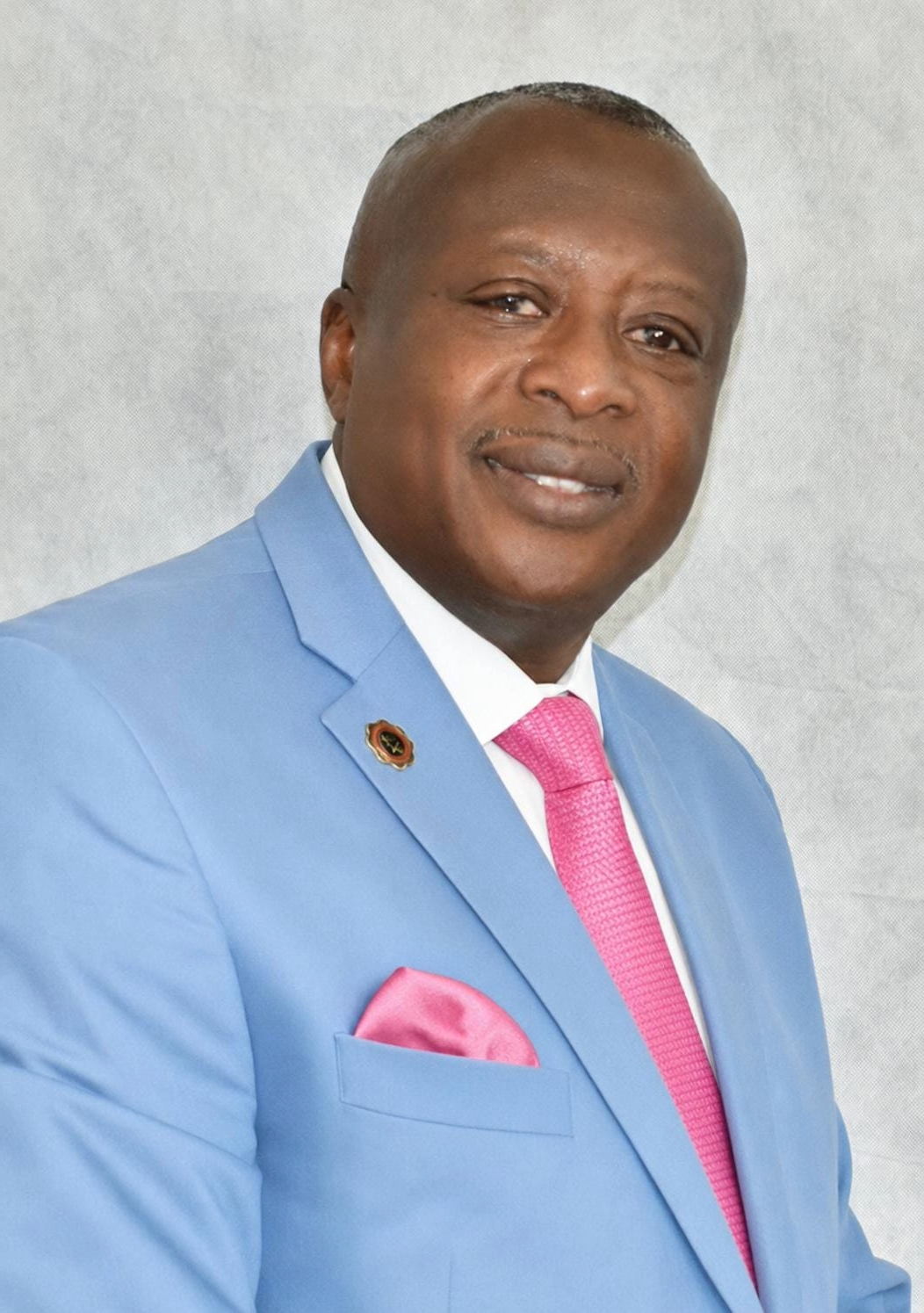
By Prof. Dr. Prince Hycy Bull, Dean, College of Education (USA)
Sierra Leone needs scientists, engineers, technologists, and other professionals capable of building the infrastructure of the future. Reliable, renewable electricity; safe drinking water; resilient roads; modern hospitals; productive agriculture; and digital services depend on people who can apply mathematics and science to practical problems. Our admissions policies must identify and develop this talent.
Poor performance on the West Africa Senior School Certificate Examination (WASSCE) English Language examination, reflecting weaknesses in preparation and other contributing factors, can prevent academically strong science students from entering disciplines essential to national development. This barrier risks weakening the talent pipeline needed to advance digital technologies and artificial intelligence.
English proficiency remains important across all disciplines. However, students with strong demonstrated abilities in science, technology, engineering, and mathematics (STEM) should not be denied admission to critical, hard-to-fill programs solely because they have not met the English Language requirement. A more constructive approach would admit these students on the strength of their scientific abilities while providing structured English instruction and requiring them to demonstrate appropriate proficiency before graduation. Such a policy would preserve academic standards while expanding the pool of professionals Sierra Leone needs.
Candidates with strong results in mathematics, physics, chemistry, or biology should have a credible pathway into higher education, even if they have not achieved the required WASSCE English Language grade. Research underscores the importance of English proficiency in science education. Devi and Arjun Singh (2026) indicate that students with stronger English proficiency perform better and demonstrate a deeper understanding of scientific analysis and interpretation. Similarly, Aina (2013) reports that limited English proficiency can significantly hinder students’ understanding of scientific concepts.
These findings support the need to strengthen English proficiency alongside scientific knowledge. Sierra Leone should therefore exempt suitably qualified science candidates from the compulsory WASSCE English Language entrance requirement and introduce a structured admissions pathway that combines demonstrated readiness in science with compulsory English language development. This short-term recommendation expands access while ensuring graduates meet rigorous academic and professional standards.
Table 1 presents the actual 2026 WASSCE results of four strong science candidates, from Kailahun District, Bombali District, and the Western Area, respectively.
Table 1
Examples of Candidates with Strong Science and Poor English Scores
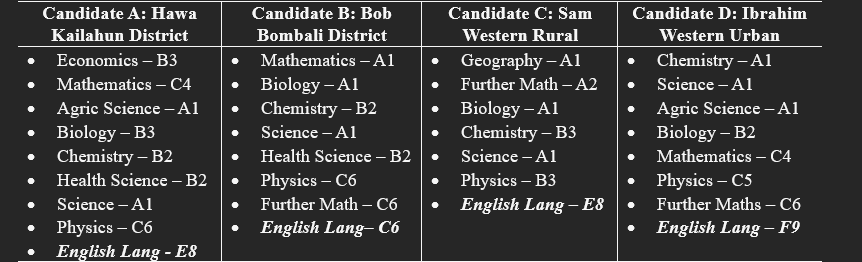
Note: Table 1 presents four science candidates with excellent science results who did not meet the English Language requirement for admission to a bachelor’s degree program.
Scientific Talent Deserves a Fair Assessment
Consider a candidate who demonstrates strong mathematical reasoning, understands scientific principles, and shows the potential to succeed in engineering, but falls short of the required English examination grade. Should that single result prevent the candidate from developing skills the country urgently needs?
An English examination provides useful evidence of language performance. It cannot, by itself, provide a complete assessment of scientific aptitude, creativity, practical ability, or readiness to receive help from further education. Admissions decisions should distinguish between a weakness that requires targeted instruction and a lack of preparation for the chosen discipline.
Universities should therefore assess science candidates primarily through their achievement in the core subjects relevant to their intended programs. Where necessary, institutions could supplement these results with mathematics and science assessments, practical tasks, or a foundation program.
Exemption from the WASSCE English entrance requirement should never mean automatic admission. Candidates must still demonstrate the academic proficiency required for their chosen field.
Building the Infrastructure of the Future
Infrastructure begins with human capacity. Before Sierra Leone can build and maintain sophisticated systems, it must prepare people who can design, operate, repair, and improve them.
Electrical engineers and technicians support power generation and distribution. Civil engineers help develop roads, bridges, drainage, and water systems. Scientists and laboratory professionals strengthen healthcare, environmental protection, and food safety. Agricultural specialists improve production and processing, while computing professionals develop digital systems and strengthen cybersecurity.
Restricting access for capable science candidates can narrow the pipeline into these fields. A more responsive admissions system would allow candidates to develop their scientific strengths while receiving deliberate support in college-level English.
Expanding this pipeline must be accompanied by investment in laboratories, qualified lecturers, equipment, internships, and effective teaching. Admission creates an opportunity; a well-supported education turns that opportunity into professional competence.
English Must Be Taught Throughout the Degree
English remains essential to university study and professional practice. Science students must understand textbooks, interpret instructions, communicate findings, and prepare accurate reports. In engineering and healthcare, misunderstanding language can also create serious safety risks.
For that reason, the proposed exemption must come with clear responsibilities for both students and institutions.
Candidates admitted through this pathway should complete an English diagnostic assessment covering reading, writing, listening, and speaking. The results should determine the support each student receives. Candidates who cannot yet understand essential instruction should complete an intensive preparatory course before entering demanding lectures, laboratories, or clinical environments.
Universities should provide compulsory academic English courses, writing support, and discipline-specific communication instruction. Students should learn to explain a mathematical solution, write a laboratory report, interpret technical guidance, and present scientific evidence.
Language development should continue throughout the program, with defined proficiency milestones and timely intervention when students struggle.
Assess English Proficiency Before Graduation
My recommendations for strengthening English proficiency in Sierra Leone propose a compulsory university and college English proficiency examination before graduation. This provides an appropriate foundation for reforming science admissions.
An entrance examination result should not be treated as a permanent guarantee of communication competence. Every graduate should demonstrate the English skills required for further study and professional work, regardless of the grade earned before admission.
The graduation assessment should cover academic and professional writing, reading comprehension, listening, and oral communication. Universities must publish clear standards and provide instruction, feedback, and reassessment opportunities.
This approach gives institutions an explicit responsibility to develop and assess proficiency during the years students spend in their care.
Establish a Responsible National Pathway
The government, higher education institutions, and relevant accreditation and professional bodies should develop a coordinated framework for this exemption. It should define eligible programs, minimum science and mathematics qualifications, language support requirements, and progression standards.
A pilot would allow participating institutions to evaluate retention, academic performance, English development, graduation, and professional readiness before expanding the approach. Programs with particular communication or safety requirements would need additional safeguards.
The pathway must also be financially accessible. If English support carries substantial extra fees, capable candidates from low-income families may remain excluded.
Meanwhile, Sierra Leone must continue to strengthen English teaching in schools through improved teacher preparation, reading and writing across the curriculum, listening practice, and access to libraries. Reforming university admission does not remove the need to improve foundational education.
Sierra Leone’s future depends on how effectively it develops its people's abilities. A strong science candidate who needs additional English instruction should have a supported route into higher education. By connecting fair access, rigorous scientific preparation, and demonstrated English proficiency before graduation, we can prepare more of the professionals needed to build the country’s future.
Conclusion
Universities should eliminate the WASSCE English Language grade as a compulsory admission requirement for science, medicine, nursing, and engineering programs. However, English Language grades of 1–5 may serve as a tie-breaker when awarding scholarships and grants to otherwise equally qualified candidates.
Under this exemption pathway, applicants should be required to achieve an aggregate score of 14 or better across six relevant science and mathematics subjects, with the required subject combination determined by their intended program of study. Applying this criterion, Candidate A would have an aggregate of 13, Candidate B an aggregate of 13, Candidate C an aggregate of 11, and Candidate D an aggregate of 14. All four candidates would therefore meet the proposed aggregate requirement to enter university.
This reform would create a pathway for academically capable candidates whose educational opportunities are constrained by their WASSCE English Language results, particularly those who lacked access to proficient English Language teachers. By combining demonstrated competence in science and mathematics with compulsory supplementary English Language instruction, universities can enable these candidates to pursue professional education while developing the language skills needed for academic and workplace success.
References:
Aina, Jacob. (2013). Students’ Proficiency in English Language Relationship with Academic Performance in Science and Technical Education. American Journal of Educational Research, 1. 355-358. 10.12691/education-1-9-2.
Devi, D. & Arjun Singh, Laishram. (2026). English Proficiency and Academic Achievement in Science among Secondary School Students. ShodhPatra: International Journal of Science and Humanities. 3. 61-69. 10.68504/SPIJSH.2026.v3.i10.45951.
Coming next: Part Four, the final installment in this four-part series, explores “[Article Title].”