Sierra Leone cybercrime raids: Large seizures, but Key questions remain.
Authorities report hundreds of detentions and the seizure of phones, passports, and servers in Freetown and Kenema. The public account has yet to establish who controlled the suspected operation or how the equipment was used.
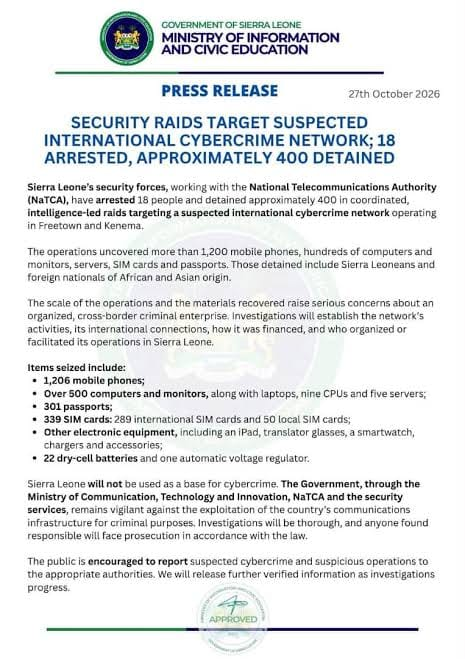
Security forces in Sierra Leone seized 1,206 mobile phones, more than 500 computers and monitors, and 301 passports during coordinated operations in Freetown and Kenema, according to a government announcement. But the reported scale of the seizures leaves a central question unanswered: what evidence links the equipment and the detained people to specific criminal offences?
In an announcement dated October 27, 2026, the Ministry of Information and Civic Education said authorities had arrested 18 people and detained approximately 400 others. It described the operations as intelligence-led and said security forces worked with NaTCA, the telecommunications regulator.
What authorities reported finding.
The announcement provides an inventory of a suspected operation. It does not, on the information available, establish how that operation functioned, who directed it, or what role each person detained allegedly played. Those distinctions matter: a seizure documents what authorities recovered, not necessarily what they have proved.
What the equipment establishes, and what it does not
Alongside the phones, computers, monitors and passports, authorities reported recovering five servers and 339 SIM cards. Of those SIM cards, 289 were described as international and 50 as locally registered. These are government-reported figures, not independently verified findings about the equipment’s use
The public accounts described do not disclose forensic findings that show how the devices were used or that connect particular individuals to alleged offences. The reported international SIM cards and passports also leave unresolved the nature and extent of any cross-border activity.
The government said investigators would examine the suspected network’s activities, financing, international connections and those responsible for organizing or facilitating it.
A missing timeline
The announcement described the operations as intelligence-led but did not explain what information first alerted authorities, when investigators received it, or how long the suspected activities had continued. It also did not establish whether earlier warnings had reached the relevant institutions.
The timing of the raids requires clarification. October 27 is the date of the government announcement. Without that timeline, it is not possible to determine whether the operations followed a timely investigation or whether authorities missed opportunities to intervene earlier. Neither institutional failure nor investigative success can be established from the seizure totals alone. The government’s distinction between 18 people arrested and approximately 400 others detained raises a separate accountability question.
The alleged organizers have not been identified. A credible account of the case must distinguish suspected organizers and facilitators from others found at the premises. The reported number of people detained cannot substitute for evidence of individual responsibility. The raids have produced a substantial government-reported inventory. What remains undisclosed is the evidentiary chain linking the premises, devices, finances, and individuals to specific alleged crimes.
That is the next test of the investigation: whether authorities can move beyond the scale of what they seized to explain what happened, who was responsible, and what evidence supports those conclusions. Until then, the reported seizures mark the beginning of the public account, not its resolution.
Editor’s note: This article is based on the government’s public account of the raids. The reported seizure figures have not been independently verified.