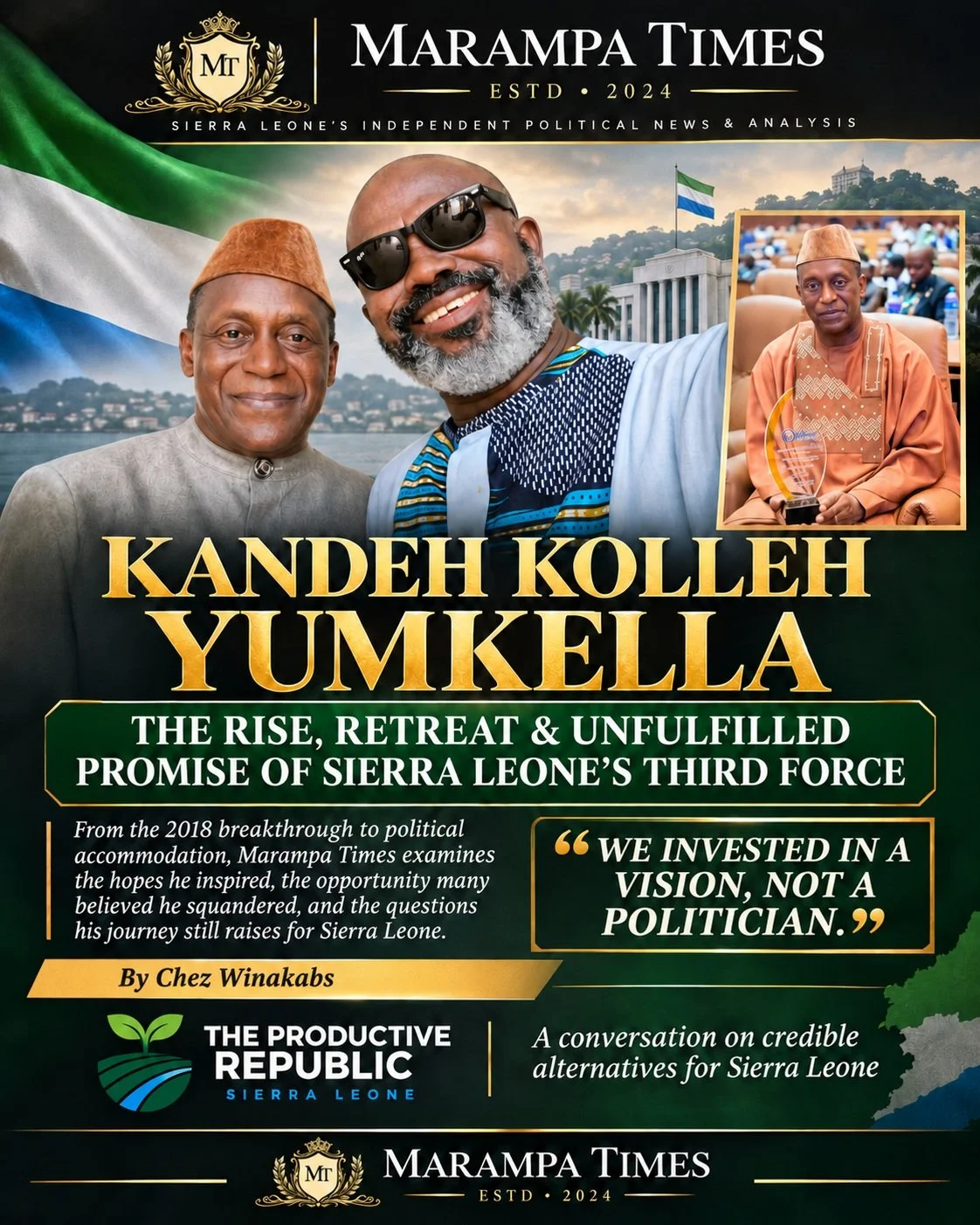
We Invested in a Vision, Not a Politician: From international distinction to electoral triumph in Kambia, from the promise of transformative leadership to political accommodation — what became of one of Sierra Leone's most significant attempts to establish an alternative to its traditional two-party political system?
Dr Kandeh Kolleh Yumkella arrived in Sierra Leonean politics with an unusual résumé. He had led the UN Industrial Development Organization (UNIDO) from 2005 to 2013 and then held senior UN energy responsibilities. For many citizens, especially younger and professionally minded ones, he promised leadership based on competence, integrity, and national interest rather than tribal or party loyalty. In 2018, his National Grand Coalition (NGC) won about 6.86 per cent of the presidential vote. It also took four of Kambia's six parliamentary seats and fourteen of its eighteen district council seats.
Eight years on, the picture is far more complicated…
By Chez Winakabs | Wednesday, 25 November 2026
There are moments in a nation's political history when an individual emerges with the credentials, intellectual capacity, public goodwill, and historical opportunity to influence its direction.
In Sierra Leone, Dr Kandeh Kolleh Yumkella was once regarded by many as such an individual.
When he emerged as a political force, many Sierra Leoneans, particularly among the younger and professionally minded generations, saw in him something different from the conventional politicians who had dominated our national affairs since independence.
What made his appeal particularly interesting was that many of his supporters were not necessarily motivated by tribal loyalties, regional sentiments or traditional party affiliations.
They were citizens who wanted their country to move forward. They wanted leadership founded upon competence, intellectual independence, integrity, productivity and national interest. Yet, eight years after his electoral breakthrough, an important question remains:
What became of the political transformation that Kandeh Yumkella inspired so many Sierra Leoneans to believe was possible?
An International Giant Returns Home
Any fair assessment of Yumkella must begin by acknowledging his professional accomplishments.
An agricultural economist by training, Yumkella served as Director-General of the United Nations Industrial Development Organization (UNIDO) between 2005 and 2013, before assuming senior United Nations responsibilities in sustainable energy.
He relinquished his international position in 2015, expressing his desire to return home and serve Sierra Leone.
His credentials were particularly relevant to a country desperately in need of industrialisation, agricultural transformation, energy security and economic development.
He understood the relationship between electricity and productivity, agriculture and manufacturing, international investment and domestic prosperity. Many of us believed that someone with such exposure could introduce a different political and developmental culture. However, international professional distinction and domestic political effectiveness are not necessarily the same thing.
My Personal Investment in the Third Force
I write this assessment not merely as a political observer but as someone who invested considerable personal resources in mobilising Sierra Leoneans to register and vote for the National Grand Coalition (NGC) during the 2018 general elections.
I was never a member of the NGC.
My involvement was driven by my conviction that Sierra Leone needed to move beyond a political culture which, in my assessment, had too frequently accommodated corruption, kleptocracy, patronage and the mismanagement of public resources, leaving generations of our fellow citizens impoverished.
I invested my time, energy and financial resources because I believed that meaningful political change required more than sitting on the sidelines and complaining about successive administrations.
For me, supporting the NGC was not principally about making Kandeh Yumkella President of Sierra Leone.
It was about helping to establish a sustainable political institution capable of challenging conventional political practices and offering citizens a credible alternative.
There is a fundamental distinction between investing in a politician and investing in a political vision.
My investment was in the vision.
That is why his eventual return to the SLPP was particularly disappointing to me.
I respect his democratic right to determine his political affiliation. Equally, I reserve my right to examine the consequences of that decision for the political movement in which many of us invested our resources and hopes.
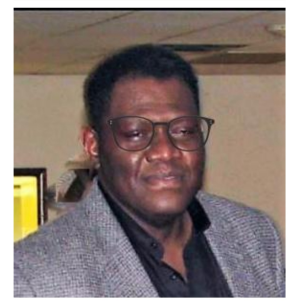
The photograph accompanying this publication recalls a personal encounter with Dr Yumkella at the lobby of the Freetown City Council.
My criticism of his political journey is not founded upon personal animosity. It arises from expectations, experience, and my conviction that public leadership must remain open to scrutiny.
The Electoral Earthquake of 2018
The performance of the newly established NGC in the 2018 general elections deserves considerable historical attention.
Despite its infancy and the formidable electoral machinery of the APC and SLPP, the NGC achieved a significant breakthrough.
Yumkella secured 174,014 presidential votes nationwide, representing approximately 6.86 per cent of the votes cast.
In his home district of Kambia, the NGC captured four of the six parliamentary seats and fourteen of the eighteen district council seats.
In other words, the NGC controlled approximately 67 per cent of Kambia's parliamentary representation and nearly 78 per cent of its district council seats. For a newly established political organisation, this was a substantial accomplishment.
Yumkella had secured something many emerging political movements spend decades attempting to acquire: a territorial stronghold, parliamentary representation, substantial local government influence and a recognisable national identity.
He had not won the presidency, but the NGC had acquired a political foundation upon which it could build. The question is: what did the NGC do with that opportunity?
Kambia Should Have Become the NGC’S Living Manifesto
Kambia is not a district without economic potential.
Its fertile agricultural lands, the Great and Little Scarcies river systems, fisheries, rice cultivation and proximity to the Republic of Guinea offer considerable opportunities for economic development.
With his background in agricultural economics and industrial development, Yumkella was particularly well placed to champion agricultural mechanisation, modern rice processing, commercial fisheries, cold-storage facilities, renewable energy, cross-border commerce and youth entrepreneurship.
Imagine a Kambia where locally cultivated rice was processed, packaged and distributed throughout Sierra Leone.
Imagine agricultural cooperatives supplying processing industries, young people acquiring technical skills and renewable energy supporting productive enterprises.
Imagine a district council publishing its revenues, expenditures, procurement contracts and development achievements for every citizen to scrutinise.
Certainly, district councils have limited statutory powers and financial resources. They cannot independently deliver everything a national government can. Nevertheless, with fourteen councillors and four parliamentarians, the NGC possessed political influence with which to mobilise development partnerships, attract investment and demonstrate accountable governance.
In my view, Kambia should have become a practical demonstration of the NGC's developmental philosophy.
People should have been able to visit the district and assess its achievements for themselves.
The NGC would not have needed to rely exclusively on Yumkella's academic qualifications, international reputation or political speeches.
Kambia itself could have become its manifesto.
The Uncomfortable Record of Kambia District Council
Perhaps the most uncomfortable aspect of the NGC's political legacy in Kambia concerns the deterioration in the district council's financial reporting.
According to the Auditor-General's 2019 annual report, Kambia District Council received an unqualified audit opinion in 2017, before the NGC's electoral breakthrough.
In 2018, the council received a qualified audit opinion.
By 2019, it had deteriorated to an adverse audit opinion, making Kambia one of only two of Sierra Leone's 22 local councils to receive such an opinion that year.
ActionAid Sierra Leone's 2020 annual report also highlighted Kambia's particularly poor audit performance.
The Auditor-General identified deficiencies in revenue documentation, asset registration and supporting financial records.
The 2019 audit queried expenditure amounting to Le245,540,000 in Old Leones for which supporting documentation had not been presented. However, fairness demands that we acknowledge the subsequent findings of the Anti-Corruption Commission.
On 30 March 2022, the ACC announced that its investigation had found no evidence of misappropriation in that particular expenditure, attributing the problem to poor records management.
A separate investigation arising from the 2021 audit identified unpaid staff social security contributions amounting to Le138,581,558 in Old Leones, although the ACC acknowledged that the liability had been inherited from a previous council administration.
The ACC also subsequently recorded significant compliance by Kambia in a separate budget utilisation monitoring exercise in 2022.
An adverse audit opinion does not automatically establish criminal corruption, and these findings do not establish personal financial wrongdoing by Dr Yumkella. Nevertheless, they raise legitimate questions of political oversight and administrative accountability.
What mechanisms did the NGC establish to strengthen financial management?
What interventions did its parliamentary representatives make following the adverse audit findings?
What institutional reforms were introduced to prevent the recurrence of such deficiencies?
A political movement seeking to reform an entire republic must be prepared to have its own performance in local government examined with equal seriousness.
From a District Victory to a National Movement — What Went Wrong?
The period between 2018 and 2023 presented an opportunity to transform the NGC from an emerging political organisation into a sustainable national institution.
Political leadership requires more than delivering impressive speeches in Parliament.
It requires building institutions, identifying successors, developing grassroots structures, producing credible policies and establishing an organisation capable of surviving beyond its founder.
The NGC faced considerable obstacles, including the established political networks, financial advantages and historical loyalties enjoyed by the APC and SLPP. Nevertheless, its experience raises questions about whether enough was done to build an independent political organisation capable of overcoming those challenges.
By 2023, even Kambia was no longer its parliamentary stronghold.
From Political Challenger to Political Partner
On 23 April 2023, Yumkella and President Julius Maada Bio formally entered into a progressive alliance between the NGC and SLPP.
Yumkella defended the arrangement in terms of national cohesion, reconciliation, forgiveness and bringing competent people together to accelerate national development.
Those arguments deserve consideration.
Political cooperation is not inherently objectionable. Participation in government can provide opportunities to implement policies that opposition politicians cannot independently deliver.
However, the alliance generated substantial divisions within the NGC, including the resignation of its chairman, Dr Dennis Bright, and other prominent members.
On 15 October 2023, Yumkella formally returned to the SLPP.
For those of us who had invested in the prospect of an independent political alternative, this represented a fundamental change in the direction of the project we had supported.
Was the alliance an exercise in political pragmatism, a genuine attempt at national reconciliation, or the consequence of difficulties in sustaining an independent political movement?
The public is entitled to examine those competing explanations against the subsequent record.
The Electoral Collapse of 2023
The Electoral Commission for Sierra Leone's declared parliamentary results for Kambia in 2023 illustrate the extent of the NGC's electoral decline.
The APC secured 57,970 votes, representing 56.36 per cent.
The SLPP secured 35,164 votes, representing 34.19 per cent.
The NGC secured only 7,381 votes, representing 7.18 per cent.
The NDA received 2,333 votes, representing 2.27 per cent.
The NGC fell below the applicable electoral threshold of 11.9 per cent and secured no parliamentary seats in Kambia.
The electoral system had changed, and the alliance with the SLPP had altered the political environment. These factors must be acknowledged when comparing the two elections.
Nevertheless, the contrast is significant.
In 2018, the NGC held four of Kambia's six parliamentary seats.
In 2023, it held none.
The experience raises an important question for every emerging political movement in Sierra Leone: how can an electoral breakthrough be converted into a durable political institution?
International Awards, National Appointments and The Reality of Electricity Poverty
Yumkella's international reputation remains substantial.
His recognition through the ECREEE–ECOWAS Lifetime Leadership Award in 2025 reflects decades of international engagement in sustainable energy.
His work within the Bio administration, particularly as Chairman of the Presidential Initiative on Climate Change, Renewable Energy and Food Security, has placed him at the centre of important national development initiatives.
In September 2025, the government announced the endorsement of Sierra Leone's US$2.2 billion Mission 300 Energy Compact.
The US$480 million Millennium Challenge Corporation compact also seeks to improve electricity distribution, transmission and sector governance. His participation in regional investment initiatives, including the West Africa Integration and Investment Summit in November 2026, deserves acknowledgement. However, investment pipelines are not completed investments. Financing commitments are not functioning infrastructure.
International awards are not electricity delivered to households.
Consider the situation in Lunsar, Marampa Chiefdom.
Residents have reported prolonged electricity deprivation dating back to approximately mid-February 2026.
I personally experienced electricity deprivation before leaving Lunsar on 2 March 2026, despite having paid for electricity.
Businesses struggle. Refrigeration becomes unreliable. Students find studying at night difficult. Consumers who have prepaid for electricity are left questioning the value of their payments.
Yumkella does not bear sole responsibility for these circumstances. Electricity provision involves several government institutions, financing arrangements and infrastructure challenges.
Nevertheless, his prominent role in national energy policy makes it reasonable to examine what his leadership is contributing towards resolving these problems.
What does internationally celebrated expertise in sustainable energy mean to a family that cannot illuminate its home?
What does industrial development mean to a young entrepreneur who cannot reliably operate electrical machinery?
What does an energy compact mean to a community that remains in darkness?
These are the domestic realities against which development initiatives must ultimately be assessed.
Delivering For a President or Delivering for a Republic?
There is a fundamental distinction between serving a president and serving a republic.
A president is a temporary occupant of public office.
The republic belongs to its citizens.
When distinguished professionals enter government, their responsibilities include bringing independent judgement, technical competence and intellectual integrity into public administration.
Their contributions should be examined through measurable public outcomes rather than political affiliations alone.
Has Yumkella's participation in government accelerated industrialisation?
Has it improved electricity reliability?
Has it facilitated sustainable employment?
Has it strengthened the institutions responsible for managing our national resources?
These questions apply not only to Yumkella but to every individual entrusted with public responsibility, irrespective of political affiliation.
The Danger of Personality-Driven Political Movements
The Yumkella experience provides a broader lesson for Sierra Leone.
Political organisations that depend excessively upon individuals risk losing their identity whenever those individuals change direction.
When the founder changes political affiliation, what happens to the institution?
When a prominent leader accepts a government appointment, what safeguards preserve the independence of the movement?
When presidential ambitions change, what becomes of the hopes and sacrifices of ordinary supporters?
A sustainable political institution must be greater than the reputation, qualifications, ambitions or personal relationships of its founder.
It requires democratic internal structures, transparent financing, accountable leadership, clear policy commitments and institutional continuity.
This is also a question that confronts every contemporary initiative seeking to develop alternative political and economic ideas for Sierra Leone, including The Productive Republic.
No political project should be exempt from the standards of accountability that it demands of others.
Questions Dr. Yumkella Should Answer
What tangible developmental legacy did the NGC leave in Kambia between 2018 and 2023?
What actions did its political leadership take in response to the council's adverse audit opinion?
Why was its substantial electoral presence in Kambia not successfully transformed into a nationwide political movement?
What measurable benefits has the Progressive Alliance delivered to ordinary Sierra Leoneans?
What concrete improvements in electricity access, reliability, industrial production and employment can be attributed to his participation in the current administration?
What institutional lessons does he draw from the electoral decline of the NGC between 2018 and 2023?
Does he still believe that an independent political alternative beyond the APC and SLPP has a legitimate place in Sierra Leone's democratic development?
CONCLUSION. We Invested in a Vision, Not a Politician
Dr Kandeh Kolleh Yumkella's political journey encompasses considerable international achievement, an important electoral breakthrough, difficult political choices and expectations that many of his former supporters believe remain unfulfilled.
He demonstrated in 2018 that Sierra Leone's established political order was not impenetrable.
He demonstrated that a newly established political party could capture parliamentary constituencies and secure substantial local council representation.
The subsequent experience raises difficult questions about how such an achievement might have been consolidated and sustained.
For my part, I remain disappointed that the political project in which I invested considerable personal resources did not develop in the direction I had anticipated.
I do not seek reimbursement for the resources I spent.
I do not claim entitlement to a political appointment or reward.
My concern is the opportunity in which I genuinely believed.
International honours will remain part of Yumkella's biography.
His electoral breakthrough will remain part of Sierra Leone's political history.
His participation in government must be examined in terms of its eventual contribution to the lives of ordinary Sierra Leoneans.
The experience has reinforced my conviction that citizens must distinguish loyalty to an individual from commitment to a national vision.
Political leaders are entitled to change their affiliations.
Citizens are equally entitled to examine those decisions, question their consequences, and demand accountability for the trust they invested.
I supported a vision for Sierra Leone. I did not purchase a lifetime subscription to Kandeh Kolleh Yumkella's political decisions.
REFERENCES AND EDITORIAL NOTES
Sierra Leone general election results, 2018.
Sierra Leone Telegraph, 11 April 2018.
Auditor-General's Annual Report on the Accounts of Sierra Leone, 2019, Table 3.2.
ActionAid Sierra Leone Annual Report, 2020.
Anti-Corruption Commission statements and monitoring reports concerning Kambia District Council.
Electoral Commission for Sierra Leone, parliamentary election results declared on 1 July 2023.
Government of Sierra Leone, Mission 300 Energy Compact announcements.
Millennium Challenge Corporation, Sierra Leone Compact.
Marampa Times distinguishes documented financial management deficiencies from proven criminal corruption. The precise uninterrupted duration of the Lunsar electricity outage remains subject to independent verification.
Dr. Yumkella and the former NGC leadership are welcome to respond to the issues raised in this publication.
Credit Source: CHEZ WINAKABS | MARAMPA TIMES; Established 2024 | Independent Journalism | Public Accountability | National Development